The longstanding leading connectivity solution for businesses, T1 service, is frequently used for dedicated internet connections, point-to-point private lines, and PBX phone trunks. T1 connections are easily accessible, cost-effective, and very dependable. However, their main selling point—fixed bandwidth of 1.5 Mbps—is now a significant drawback.
While 1.5 Mbps still satisfies the needs of many small businesses and less tech-dependent companies, this is changing quickly. Professionals in fields like insurance, medicine, video production, and engineering all require strong connections. Whether through private lines, virtual private lines, or dedicated internet access, they need significantly more bandwidth than the outdated 1.5 Mbps.
10 Mbps is emerging as the new standard. This shift is driven by evolving bandwidth needs. Most internet users have transitioned from dial-up to broadband. The wireless industry is under pressure to advance from 3G speeds (around 1 Mbps) to 4G, offering download speeds of 3, 6, 10 Mbps and higher, with at least 1 Mbps upload speeds.
Computing advancements now hinge on broadband speeds. Computers, including Macs, now boast multi-gigabyte memories, terabyte storage, and multi-core processors, giving them ample processing power. Even tablets utilize multi-core processors and connect to WiFi, 3G, or 4G broadband. As a result, WANs have become a bottleneck, limiting data flow to and from these powerful devices.
This bottleneck wasn’t as significant a few years ago when computing was primarily local. Software was either installed directly on PCs or accessed through corporate servers on Local Area Networks. Webpages were basic and static, email was a simple text-based service, and e-commerce platforms, while sophisticated, didn’t require extensive data transfer.
Currently, higher resolution screens and the prevalence of high-resolution cameras have increased the demand for high-resolution graphics and video content, which now makes up a significant portion of WAN traffic. Furthermore, with the shift towards cloud computing, where data centers are accessed remotely, a large amount of data travels to and from the cloud via WAN connections, demanding higher bandwidth for optimal performance.
TelePacific, a carrier addressing the demand for higher business bandwidth, is deploying “Ethernet over Anything” (EoX). EoX utilizes copper, TDM, fixed wireless, or fiber optic cabling to provide Ethernet connectivity. The advantages of Ethernet include cost-effectiveness compared to traditional telecom services, seamless integration with corporate LANs, and easy bandwidth scalability. Ethernet over Copper (EoC) is particularly favored, offering higher bandwidth and lower costs per Mbps than T1 lines using existing copper infrastructure.
Achieving 10 Mbps over T1 lines would necessitate bonding seven lines, significantly increasing costs. In contrast, 10 x 10 Mbps Ethernet over Copper can be acquired for half the price or less. This bandwidth can be easily scaled up to 15, 20, 25 Mbps, or more as needed. Notably, 10 Mbps EoC service today is priced similarly to a single T1 line a few years ago.
If you find your WAN bandwidth, particularly an older T1 line, to be insufficient, an upgrade is likely more affordable than you think. 10 Mbps or higher is within reach. Discover the possibilities by exploring prices and availability for Ethernet bandwidth services that suit your business location.

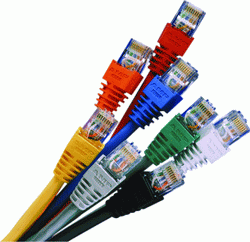
Note: Ethernet patch cords photo courtesy of Wikimedia Commons.
