As companies increasingly adopt cloud services and engage in data-heavy activities like video streaming and big data analysis, the demand for greater WAN bandwidth is on the rise. It’s becoming commonplace to see requests for 1,000 Mbps connections, often fulfilled by a 1 Gbps Ethernet or GigE point-to-point connection. Let’s explore the details and available choices for Gigabit Ethernet service.
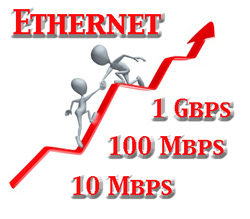
Ethernet, the standard protocol for LANs, commonly operates at speeds of 10 Mbps, 100 Mbps, 1,000 Mbps, or 10 Gbps. Many network devices support multiple speeds, typically 10/100/1000 Mbps. It’s a natural progression to want to extend the LAN’s reach through the WAN to connect with another LAN. The key to avoiding bottlenecks that cause network congestion, while simultaneously preventing overspending on excessive WAN bandwidth, is to align your LAN and WAN speeds. This means using consistent LAN speeds and protocols.
Fortunately, the Metro Ethernet Forum (MEF), an industry group responsible for establishing vendor interoperability standards, has addressed this need. They’ve developed the necessary standards to enable the transportation of LAN Ethernet over WAN connections, known as Carrier Ethernet within the WAN environment.
This process begins and ends with a User Network Interface (UNI), a “port” installed at the user’s location(s) by the carrier or service provider. UNIs are designed to operate at standard LAN speeds: 10 Mbps, 100 Mbps, 1 Gbps, or 10 Gbps. However, this doesn’t restrict you to just these service speeds. The installed UNI determines the maximum bandwidth it can handle. The actual service speed is controlled by the carrier, limiting it to match your purchased bandwidth, which could be 20 Mbps, 75 Mbps, 450 Mbps, or another increment. This flexibility ensures you only pay for the bandwidth you actually require.
This setup offers a significant benefit. Not only are you not bound by a service that’s either insufficient or excessive for your needs, but the hardware is equipped to support the UNI’s port speed. The service provider can easily adjust the rate limiting via software, allowing for quick bandwidth increases. This means you can request a bandwidth upgrade and have it implemented potentially within hours or days. The carrier simply implements the change and modifies your billing accordingly. This streamlined approach contrasts sharply with traditional telecom services, which often necessitate on-site visits to install new equipment or wiring. As long as your UNI supports 1 Gbps, no hardware upgrades are needed until you exceed that speed.
The actual data transfer occurs over an Ethernet Virtual Connection (EVC), providing a point-to-point link between specific UNIs and preventing data exchange between sites that aren’t part of the same EVC. This widely used Ethernet point-to-point service is known as EPL or Ethernet Private Line, serving as a direct replacement for TDM private lines.
An interesting characteristic of Ethernet UNIs is their ability to manage multiple EVCs. This might seem unusual compared to typical telecom UNIs that connect physical wires and carry a single Point-to-Point (PTP) line service. You can think of each EVC as a separate private line. This delivery of multiple EVCs over a single UNI is referred to as EVPL or Ethernet Virtual Private Line service. A common topology is a hub-and-spoke configuration, where a central headquarters connects to various branch offices using EVPL. In this setup, only a single physical UNI is required at the headquarters to support all the private line spoke connections.
Is your business ready to embrace higher bandwidth WAN service? Explore the affordability of supporting 1 Gbps Point to Point Ethernet Connections using EPL and EVPL.

